Introduction
As businesses continue to digitize their operations, protecting sensitive documents has become more critical than ever. Contracts, invoices, purchase orders, legal agreements, HR records, and financial documents are frequently exchanged electronically, making them vulnerable to unauthorized modifications, forgery, and cyber threats.
Digital signatures provide a secure, legally recognized, and efficient method of protecting electronic documents. Built on Public Key Infrastructure (PKI) technology, digital signatures not only verify the authenticity of a document but also ensure that it has not been altered after signing.
In this article, we’ll explore how digital signatures significantly improve document security and why organizations across industries are adopting them.
What Is a Digital Signature?
A digital signature is a cryptographic mechanism that securely binds a signer’s identity to an electronic document. Unlike a scanned handwritten signature, a digital signature uses encryption and digital certificates issued by trusted Certificate Authorities (CAs) to verify the identity of the signer.
Each digitally signed document contains encrypted information that allows recipients to verify:
- The identity of the signer
- Whether the document has been modified
- The time the document was signed
- The validity of the digital certificate
Why Document Security Matters
Organizations handle thousands of confidential documents every day. Without proper security, businesses face risks such as:
- Document tampering
- Identity fraud
- Unauthorized access
- Data breaches
- Legal disputes
- Financial losses
- Regulatory non-compliance
Traditional paper-based approvals and manually signed PDFs offer little protection against these risks.
Digital signatures address these security challenges by providing multiple layers of protection.
How Digital Signatures Improve Document Security
1. Ensures Document Integrity
One of the most important security benefits is document integrity.
When a document is digitally signed, a unique cryptographic hash (digital fingerprint) is generated. If even a single character or punctuation mark is changed after signing, the hash changes immediately.
The signature becomes invalid, alerting recipients that the document has been altered.
Benefit:
- Prevents unauthorized modifications
- Detects tampering instantly
- Maintains trust in electronic documents
2. Verifies the Identity of the Signer
Digital signatures authenticate the identity of the person signing the document.
Before issuing a Digital Signature Certificate (DSC), the Certificate Authority verifies the signer’s identity. This certificate is then securely used during the signing process.
Recipients can verify that the document was genuinely signed by the intended individual.
Benefit:
- Eliminates impersonation
- Prevents signature forgery
- Builds confidence between business partners
3. Protects Against Fraud
Fraud involving forged signatures or modified documents can result in significant financial losses.
Digital signatures help prevent fraud by:
- Authenticating the signer
- Preventing unauthorized edits
- Validating certificate authenticity
- Recording signing activity
Benefit:
- Reduces document fraud
- Protects sensitive information
- Strengthens business trust
4. Provides Non-Repudiation
Non-repudiation means the signer cannot later deny signing the document.
Since the signature is uniquely linked to the signer and protected using cryptographic keys, it becomes legally difficult to dispute the transaction.
This is particularly valuable for:
- Contracts, Purchase Orders, Financial Agreements, Insurance Documents, Government Applications etc.
Benefit:
- Reduces legal disputes
- Improves accountability
- Creates legally defensible records
5. Encrypts Sensitive Information
Many digital signing solutions integrate encryption with digital signatures.
Sensitive documents can be encrypted during transmission, ensuring only authorized recipients can access them.
Even if intercepted, encrypted documents remain unreadable without the correct decryption key.
Benefit:
- Protects confidential business information
- Secures communication channels
- Reduces cyber risks
6. Creates an Audit Trail
Modern digital signature platforms automatically generate detailed audit logs.
These records typically include:
- Signer’s identity
- Date and time of signing
- IP address
- Certificate information
- Signing status
- Verification history
The audit trail provides complete transparency throughout the document lifecycle.
Benefit:
- Simplifies compliance audits
- Improves traceability
- Enhances accountability
7. Meets Regulatory and Legal Requirements
Many industries require secure electronic documentation to comply with regulations.
Digital signatures help organizations meet compliance requirements across sectors including:
- Banking & Financial Services
- Healthcare
- Government
- Manufacturing
- Pharmaceuticals
- Legal Services
- Insurance
In India, digital signatures are legally recognized under the Information Technology Act, 2000, making them suitable for a wide range of electronic transactions.
Benefit:
- Supports regulatory compliance
- Enables legally valid electronic records
- Reduces compliance risks
8. Secures Remote Workflows
Remote and hybrid work environments require employees to approve documents from anywhere.
Digital signatures allow secure document signing without compromising security.
Employees can securely sign:
- Employment letters
- Vendor agreements
- Purchase approvals
- HR documents
- Customer contracts
Every signature remains authenticated and verifiable.
Benefit:
- Enables secure remote collaboration
- Eliminates physical paperwork
- Speeds up approvals
9. Prevents Unauthorized Access
Enterprise digital signature solutions often integrate with:
- User authentication
- Multi-factor authentication (MFA)
- Role-based access control
- Identity management systems
- Hardware Security Modules (HSMs)
Only authorized users can initiate signing operations, significantly reducing the risk of unauthorized access.
Benefit:
- Strengthens access security
- Protects critical business documents
- Minimizes insider threats
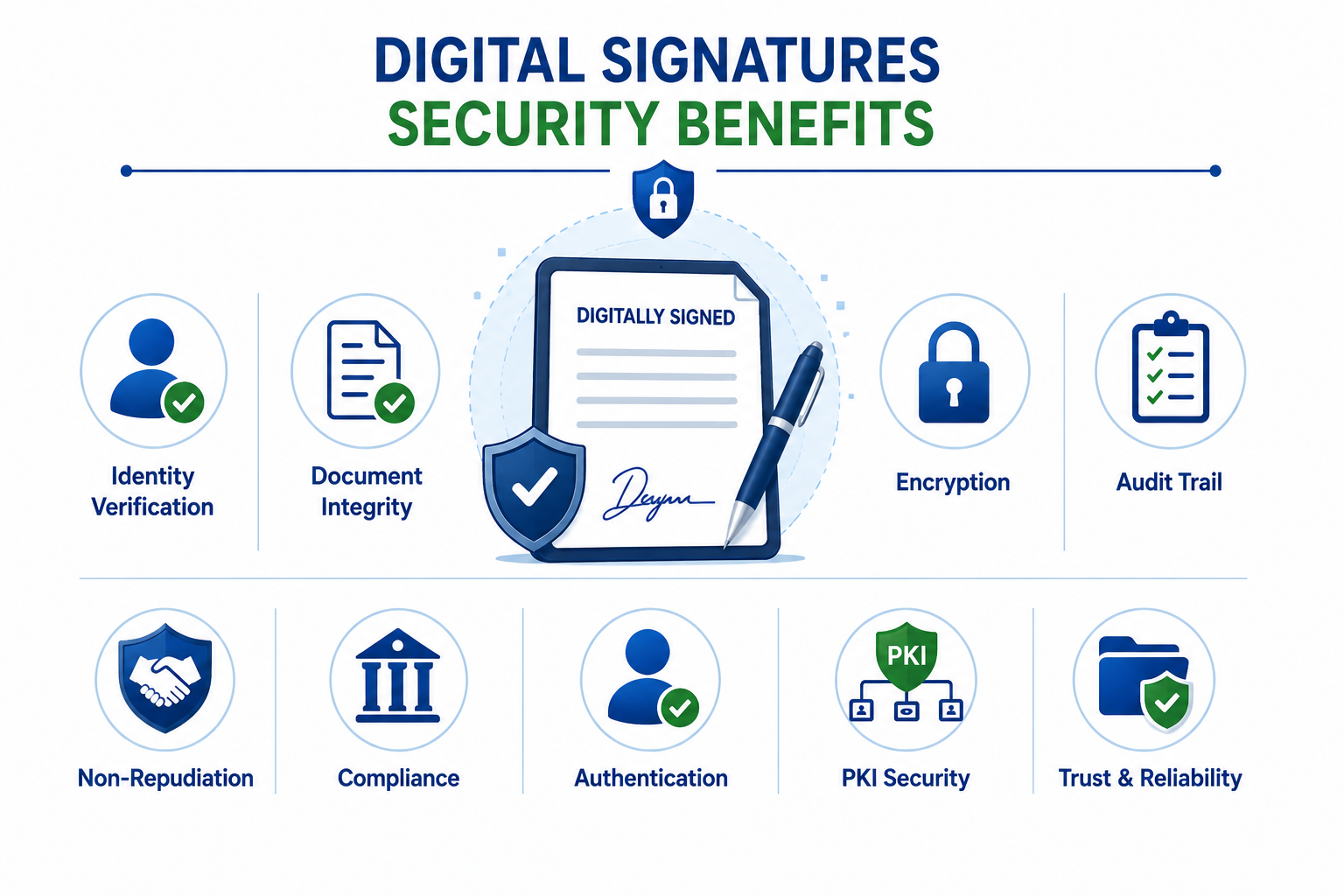
| Feature | Security Benefit |
|---|---|
| Identity Verification | Confirms signer authenticity |
| Document Integrity | Detects any modifications |
| Encryption | Protects sensitive information |
| Audit Trail | Complete signing history |
| Non-Repudiation | Prevents denial of signature |
| Compliance | Meets legal and regulatory requirements |
| Authentication | Prevents impersonation |
| PKI Security | Trusted cryptographic protection |
Best Practices for Secure Digital Signing
To maximize document security:
- Use digital certificates from trusted Certificate Authorities.
- Protect private keys using secure devices or Hardware Security Modules (HSMs).
- Enable multi-factor authentication for signing users.
- Regularly renew digital certificates before expiration.
- Verify certificate revocation status during signature validation.
- Maintain comprehensive audit logs.
- Use trusted digital signature software that complies with industry standards.
Secure Your Digital Documents with E-Lock Digital Signing Solutions
As organizations accelerate their digital transformation, choosing a trusted digital signature solution becomes essential for protecting sensitive business documents and streamlining approval workflows. E-Lock Technologies is a leading provider of PKI-based digital signature solutions, helping organizations securely sign, verify, and manage electronic documents across a wide range of industries.
E-Lock’s Digital Signing Solution enables businesses to automate document signing processes while ensuring authenticity, integrity, and legal compliance. Whether deployed on-premises or in the cloud, the solution integrates seamlessly with enterprise applications such as ERP, SAP, CRM, document management systems, and custom business applications through easy-to-use APIs.
Designed for high-volume document processing, E-Lock supports secure server-side digital signing using Hardware Security Modules (HSMs) as well as client-side signing using Digital Signature Certificates (DSCs) stored on USB tokens or smart cards. Every digitally signed document is protected against tampering, and signatures can be independently verified to ensure the signer’s identity and document integrity.
With comprehensive audit trails, strong encryption, and compliance with industry standards, E-Lock helps organizations reduce paperwork, accelerate business processes, improve operational efficiency, and strengthen document security. From invoices, purchase orders, contracts, and HR documents to regulatory filings and customer agreements, E-Lock’s digital signing solutions empower businesses to confidently embrace secure, paperless workflows.
Conclusion
As organizations increasingly rely on digital documents, ensuring their authenticity and integrity is essential. Digital signatures offer a secure, reliable, and legally recognized solution to protect electronic records from tampering, fraud, and unauthorized access.
By leveraging PKI-based encryption, identity verification, audit trails, and compliance-ready workflows, digital signatures help businesses safeguard critical information while improving operational efficiency. Whether you’re handling contracts, invoices, HR records, or regulatory documents, adopting a robust digital signature solution is a strategic step toward a more secure and trusted digital ecosystem.
Investing in digital signature technology today not only strengthens document security but also prepares your organization for the future of secure digital business.